Redesigning ARED Furniture Repair's Website from 800 Miles Away
A case study of redesigning a furniture repair website in Wylie, TX. How a conversation at my dad's house turned into my first freelance client, and what I found under the hood of a site that scored 99 on Lighthouse.

- 75%
- cheaper per month
- 0
- broken links (was 7+)
- 100
- accessibility score
In short
- ARED was paying $200 a month to a Dallas agency. The site had seven broken links, a dead Facebook icon, and the wrong zip code on the contact page.
- I rebuilt it from scratch in Astro. New homepage, real photos of the workshop, a working contact form, and a sticky call/quote bar on mobile.
- $49 a month instead of $200. Accessibility went from 91 to 100. Nothing the old site did, the new one doesn't.
This one started with my dad.
He lives in Wylie, Texas, a small city about 30 miles northeast of Dallas. He had some furniture that needed work and called ARED Furniture Repair to come take a look. While they were at his house appraising the pieces, my dad did what dads do and started asking questions. How’s business? How do people find you? Do you have a website? How much do you pay for it?
Edward, one of the sons who helps run the business, told him they pay about $200 a month to a web design agency in Dallas. That agency built and maintains the site, and the monthly fee includes some kind of “SEO package.”
My dad called me after. He knew I’d been building websites and figured $200 a month sounded steep. He was right to ask. I pulled up aredrepair.com to see what that money was actually buying.
What $200 a Month Was Buying
On the surface, the site looked okay. Clean layout, some photos, a contact form. Lighthouse gave it a 99 for performance, which is the kind of number most developers see and move on from.
But Lighthouse doesn’t click on things. I did.
The Facebook icon in the header links to #. It goes nowhere. Has been a dead link on every page of the site, probably since the day it shipped. The four service category cards on the homepage, the ones meant to help visitors find what they need? All four link to #. The “See Our Work” button at the bottom? Also #.
The contact page listed their address as “Wylie, TX 75024.” That zip code is Plano, not Wylie. Their actual zip is 75098.
The portfolio page opened with two dense paragraphs of keyword-stuffed text before showing any photos, and the photos themselves were static thumbnails. No lightbox, no way to enlarge them, no before-and-after comparison. For a business whose entire pitch is “look at the quality of our work,” that’s a real problem.
The privacy policy page still had WordPress “Suggested text:” labels visible. And the site’s REST API was wide open, exposing the admin username to anyone who knew where to look.
All of this on a site scoring 99 on Lighthouse. Lighthouse measures speed and code quality. It does not measure whether your website actually works for the people trying to use it.
That $200 a month SEO package? I counted seven broken links. Basic stuff, like making service cards clickable. Whatever they were paying for, they weren’t getting it.
Building the Pitch
I didn’t cold-call ARED. I built the site first. Took their existing content and photos, rebuilt everything from scratch in Astro, and made sure I had something concrete to show before I ever asked for a meeting.
A few weeks later, my dad went into their shop. He called me, handed the phone to Edward, and we did a conference call right there. I walked them through the new design, showed them the before-and-after of their own site, and explained what I’d found: the broken links, the wrong zip code, the dead Facebook icon that had been sitting there the whole time.
It took them about two weeks to decide. That’s normal. Switching providers is a big call for a small business, even when the problems are obvious. They’re trusting someone new with the thing every potential customer sees first. I didn’t push. The work was doing its own arguing.
The Redesign
ARED has been in business since 1980. They do furniture repair, antique restoration, custom upholstery, and refinishing out of a workshop in Wylie, and they serve the whole DFW metroplex. The new site had to feel as established as the business itself without acting like it was built in 2003.
Here’s what changed, page by page.
Homepage
The old homepage had a keyword-stuffed heading (“Expert Furniture Repair & Antique Restoration Services in Wylie, TX & Near You in DFW”) and a single CTA that linked to #. The new homepage leads with their history, has two calls to action that actually go somewhere, and surfaces the things people care about above the fold: 45+ years in business, free pickup and delivery, family owned and operated.
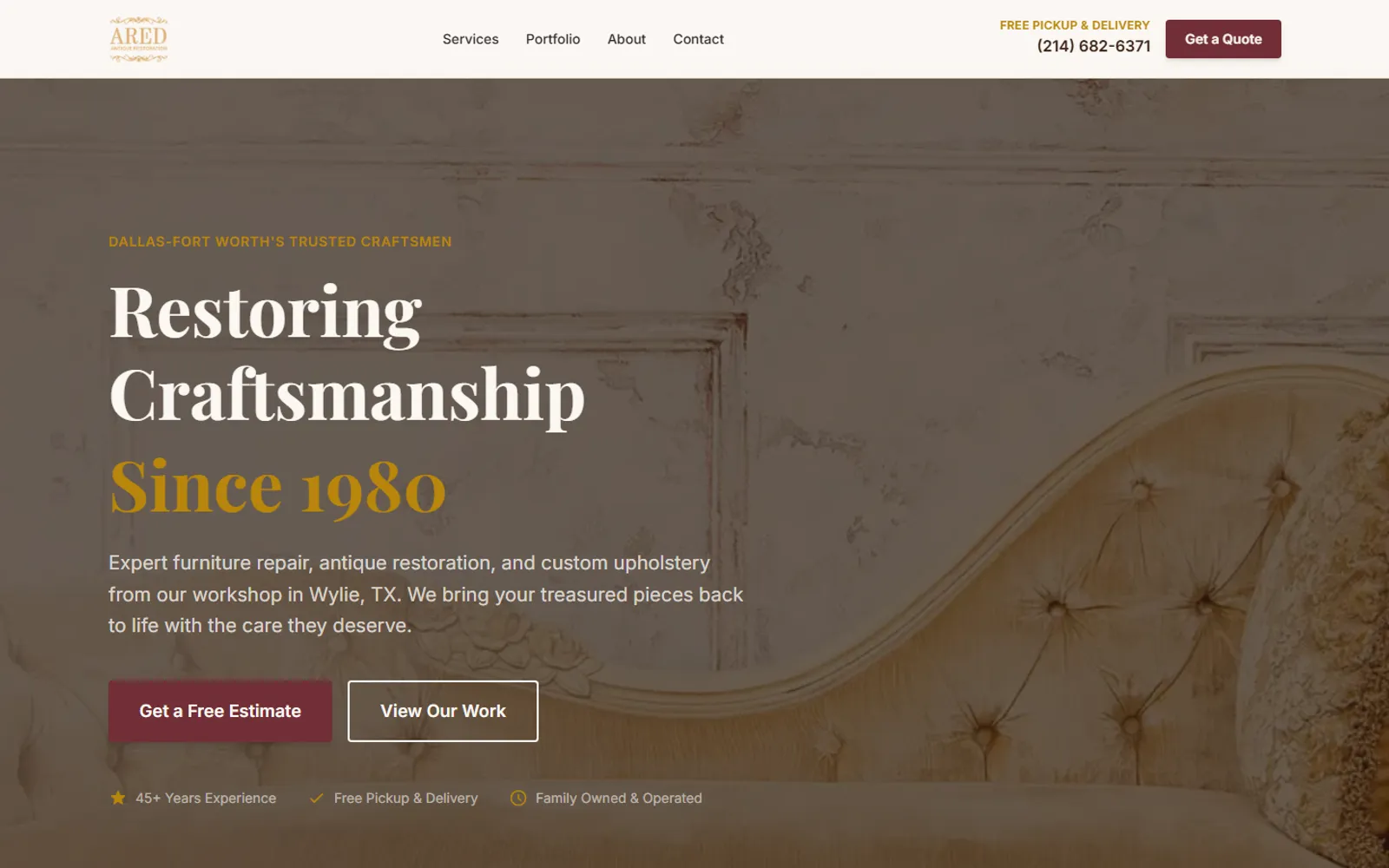 After
After 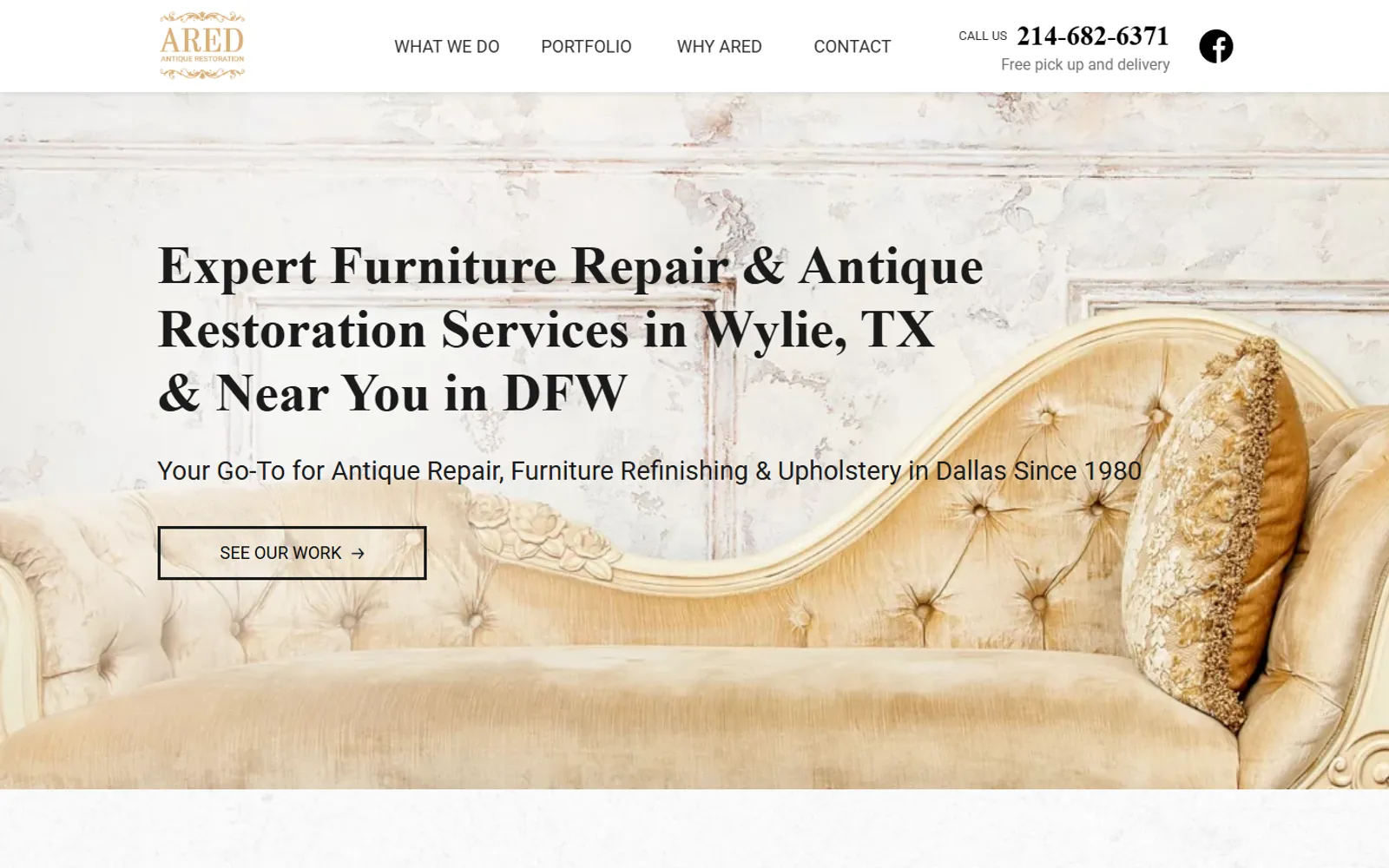 Before
 Services
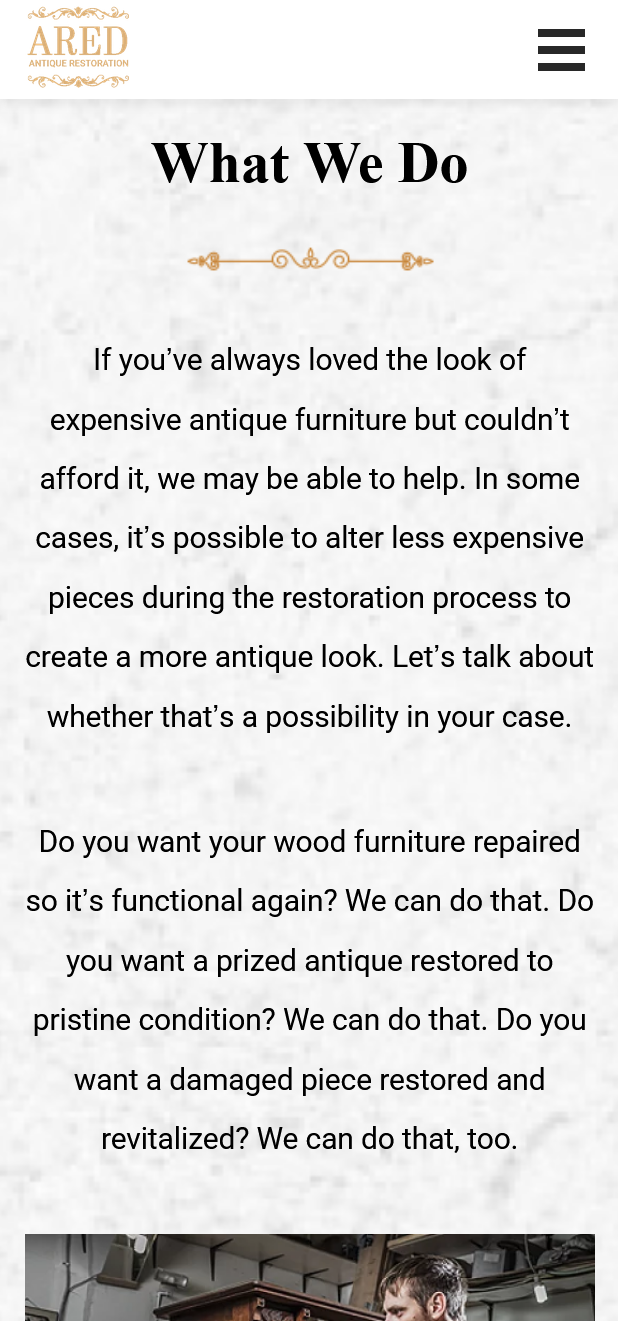
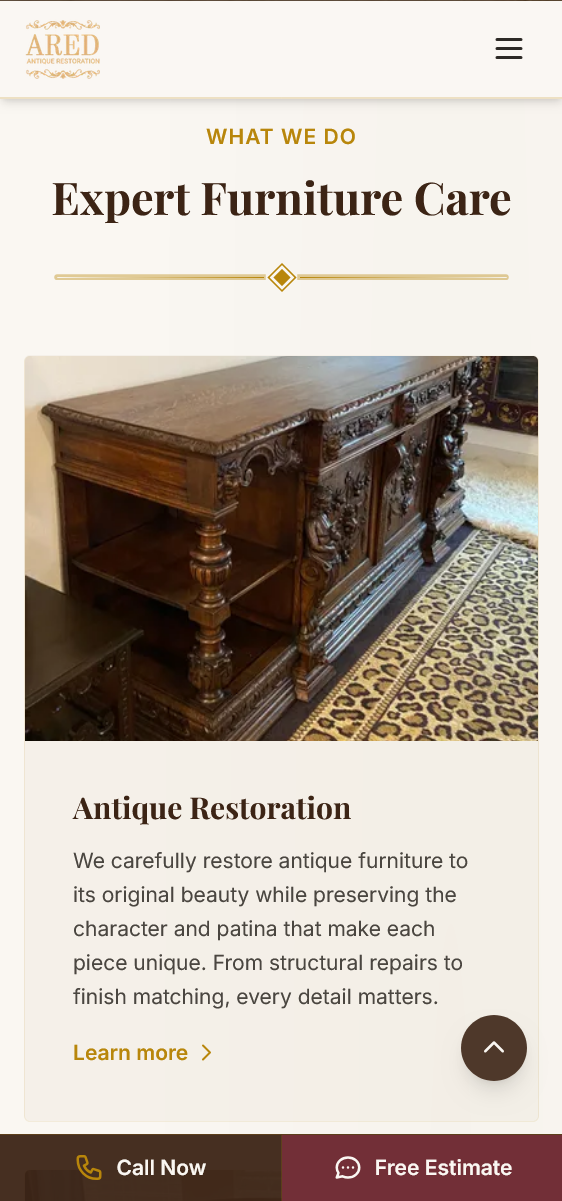
The old “What We Do” page listed services in paragraph text, with clickable cards that went nowhere. The photos were stock images, not actual work ARED had done. The new page shows each service category with real photos from their workshop and descriptions you can scan in a few seconds. When someone is deciding whether to hand over a family heirloom, stock photos don’t cut it.
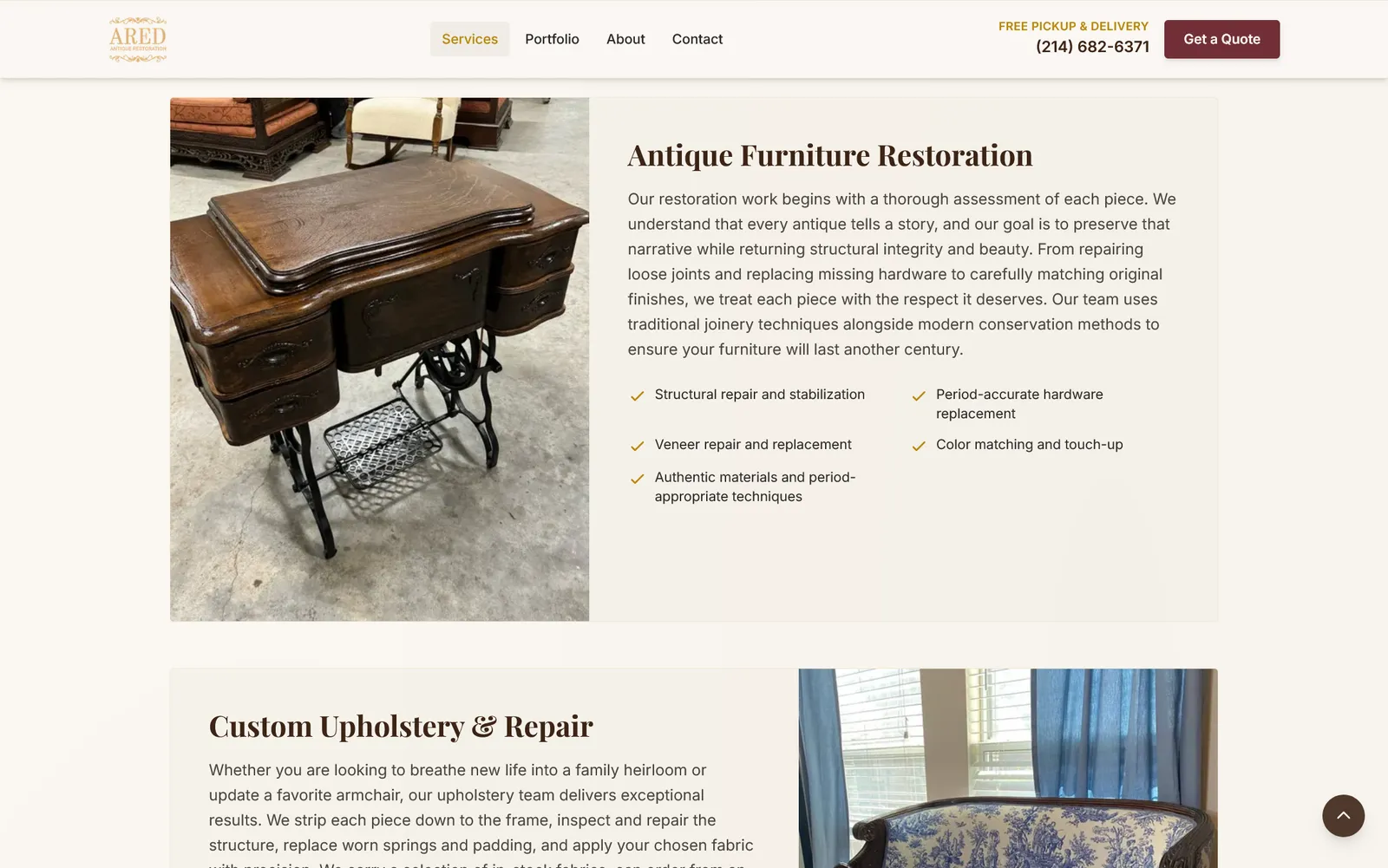 After
After 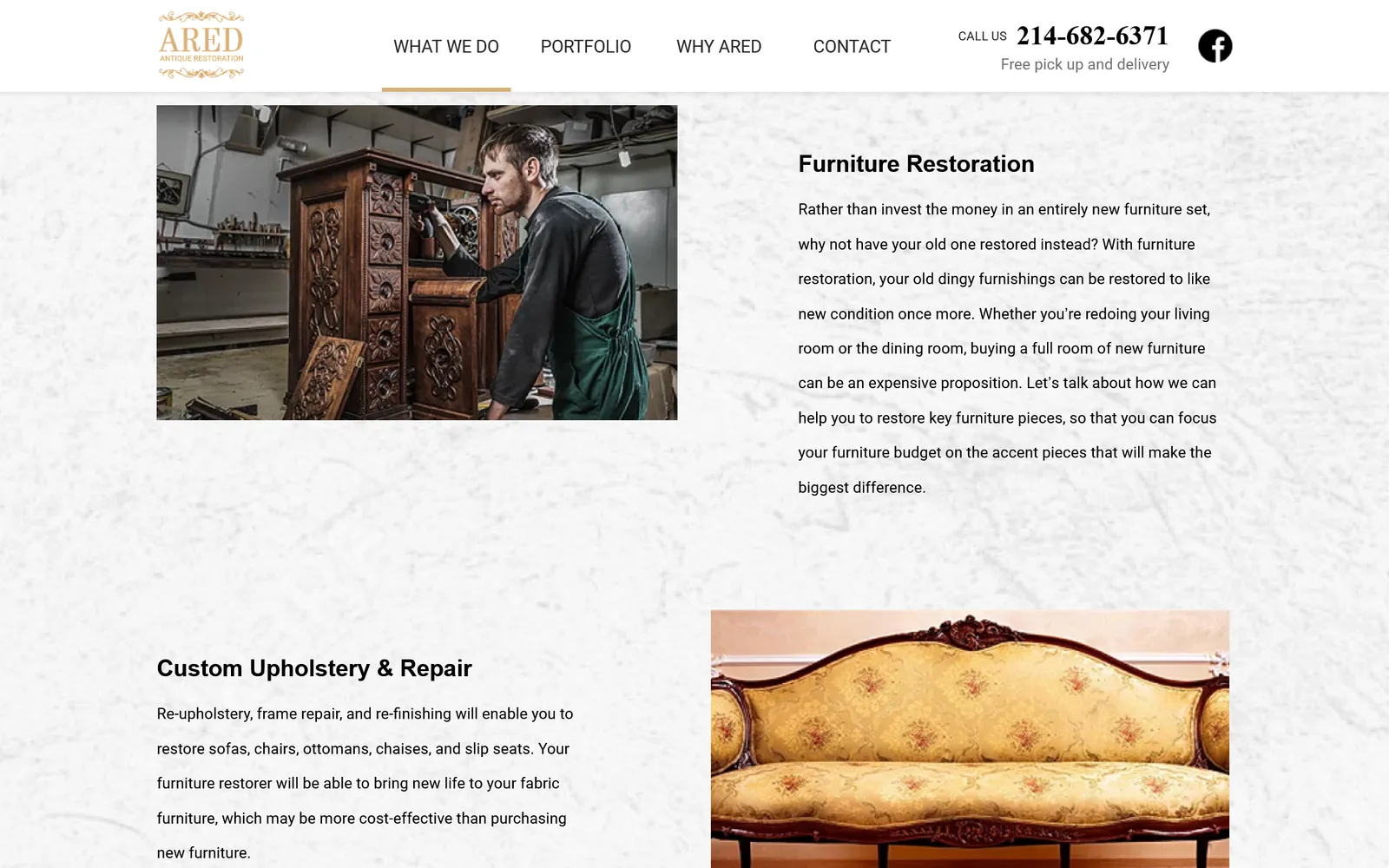 Before
 Portfolio
For a furniture repair business, the portfolio is the most important page on the site. People need to see what you can do before they trust you with their grandmother’s dining table. The old portfolio opened with two dense paragraphs of keyword soup, followed by a grid of tiny non-clickable thumbnails. The new page leads with featured restorations, then a real before-and-after gallery, then the full project archive below.
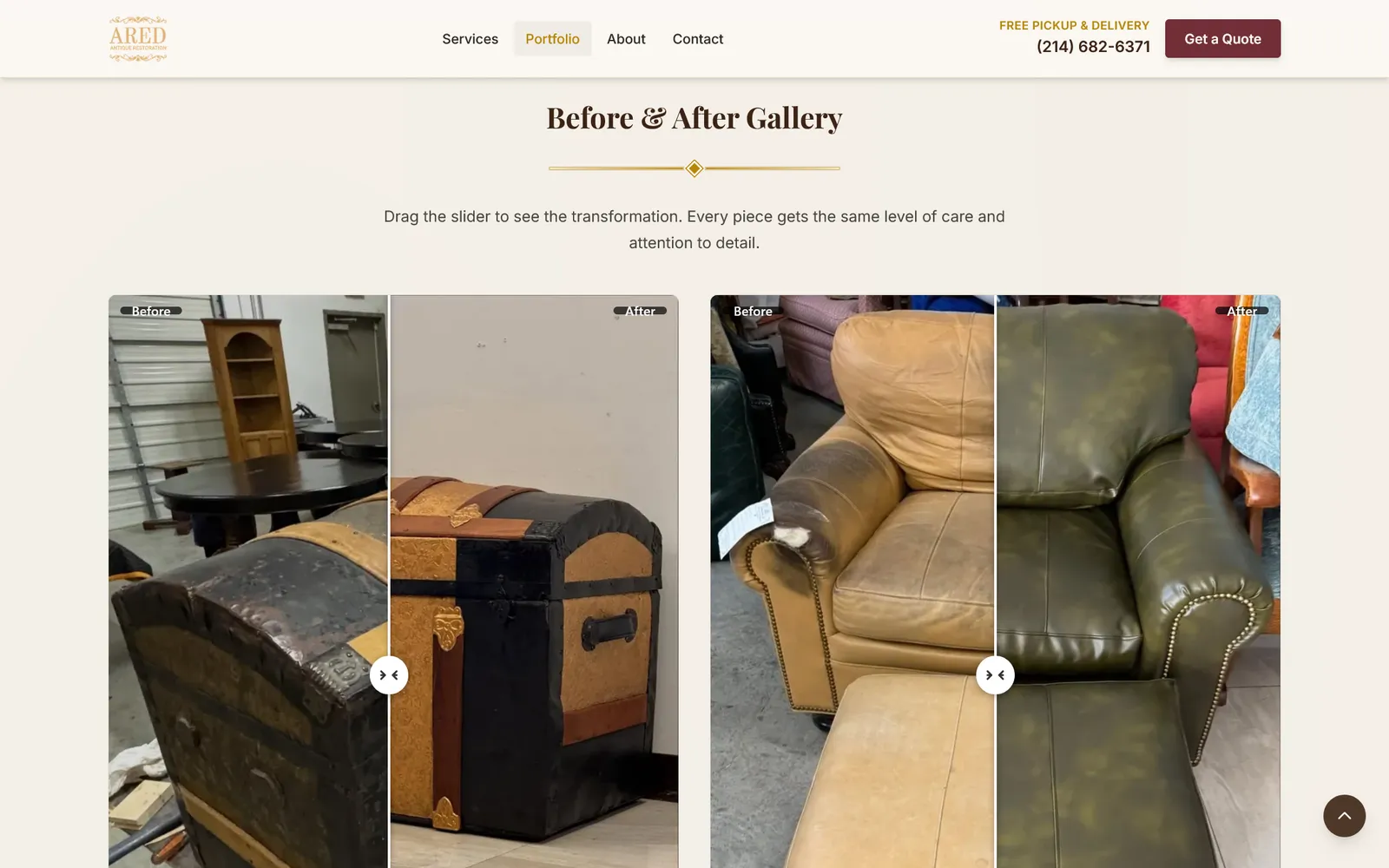 After
After 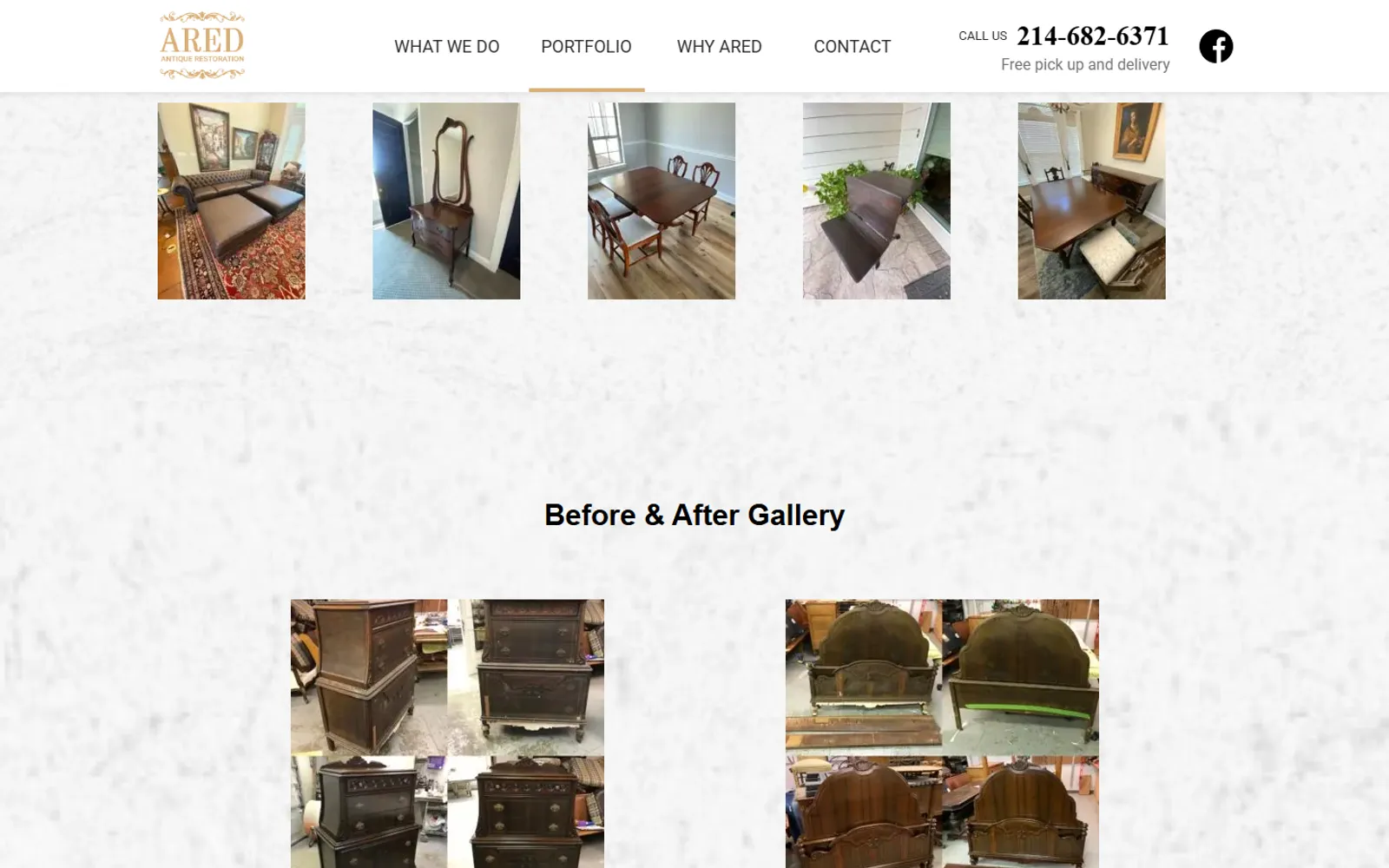 Before
 Contact
The old contact page listed the wrong zip code (75024 is Plano, not Wylie) and the address was a dead link. The new page has the correct address and zip (75098), business hours, a working form, and a clickable phone number on mobile. There’s also a list of every city they serve in the DFW area, so someone searching from Plano or McKinney knows they’re in range.
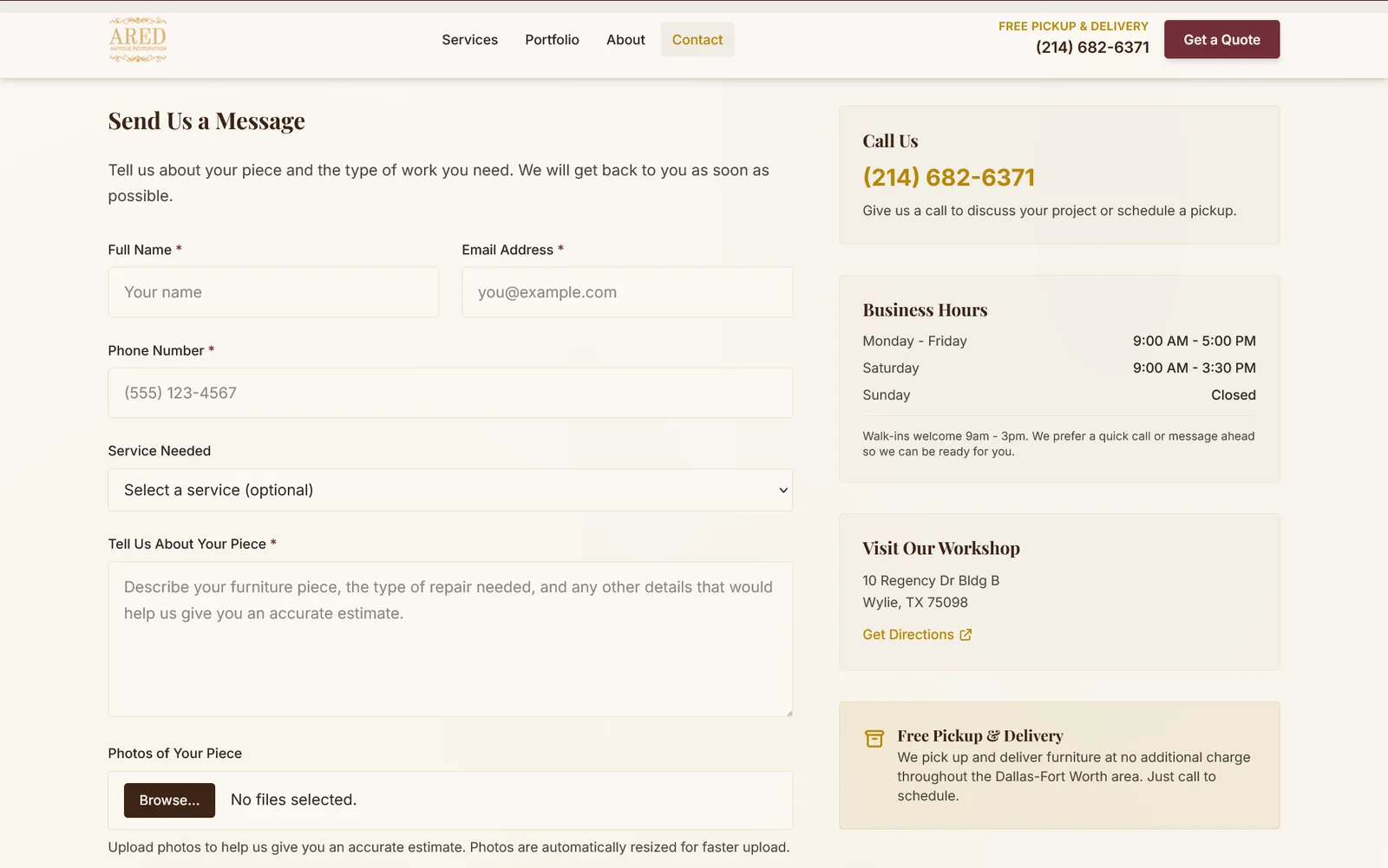 After
After 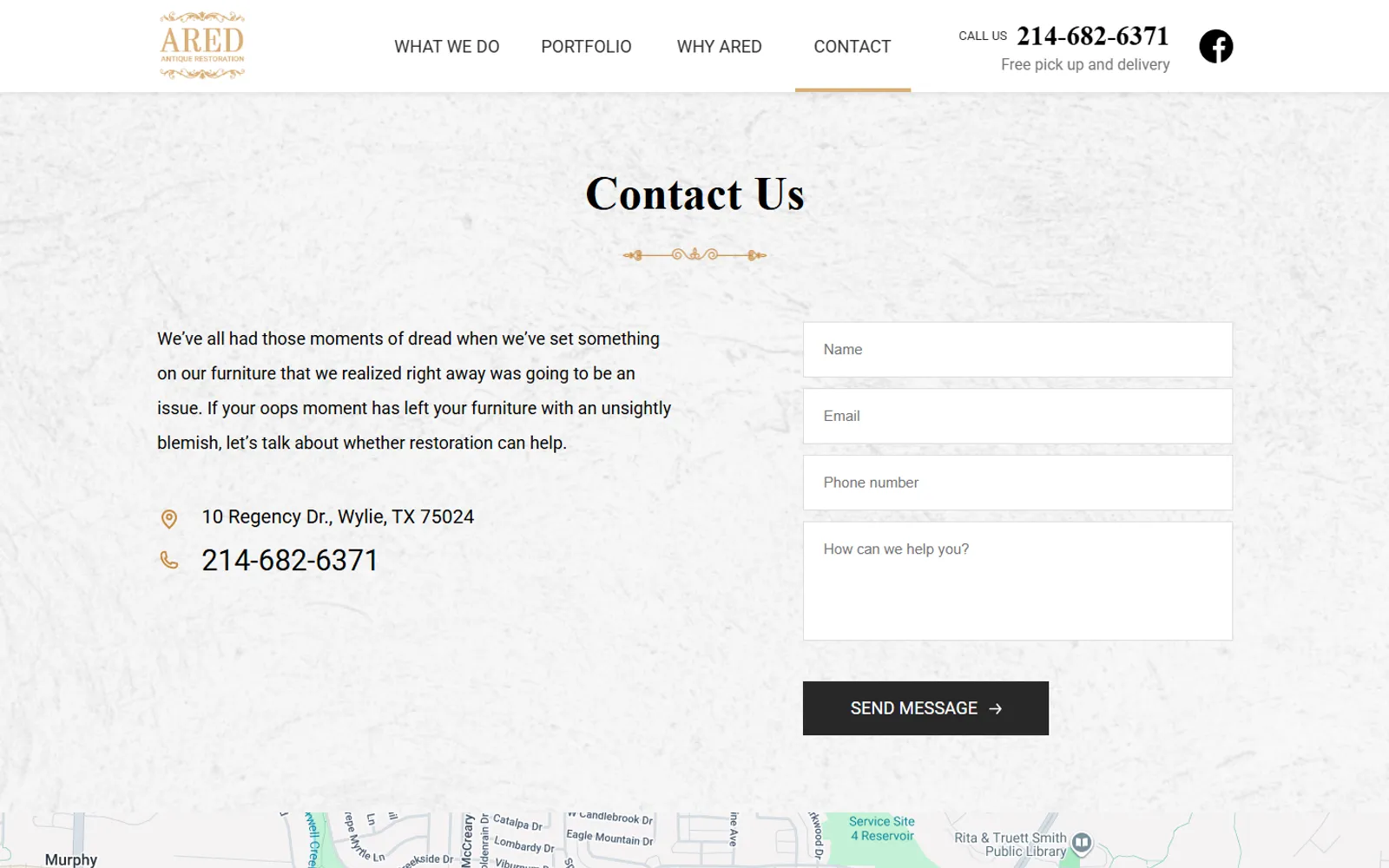 Before
 Mobile
The old site was responsive enough, but the new design adds a sticky bottom bar with “Call Now” and “Free Estimate” buttons that follow you as you scroll. On mobile, every page is one tap away from a phone call or a quote request. No hunting for the contact page.
The Numbers
Here’s the under-the-hood comparison.
| Metric | Old Site | New Site |
|---|---|---|
| Performance | 99 | 99 |
| Accessibility | 91 | 100 |
| Best Practices | 100 | 100 |
| SEO | 100 | 100 |
| Largest Contentful Paint | 2.3s | 1.9s |
| Total Blocking Time | 12ms | 0ms |
| Page Weight | 589 KB | 392 KB |
| Broken Links | 7+ | 0 |
The performance scores are nearly identical, and that’s the point. The old site’s Lighthouse numbers were fine. The actual problems were everywhere Lighthouse doesn’t look: broken navigation, dead social links, the wrong zip code on the contact page, a portfolio that couldn’t show off the work. A perfect Lighthouse score is worth nothing if a visitor can’t find what they came for or get in touch when they’re ready.
The Technical Stack
- Astro for static site generation. Every page is pre-built HTML. No server, no database, no WordPress to maintain or patch.
- Vanilla CSS with custom properties. No framework, no build-time bloat.
- Netlify for hosting. Automatic HTTPS and instant deploys on every git push.
- Optimized images in modern formats at sane sizes. No 3MB photos loading on a phone screen.
- Schema.org structured data for the business, the services, and the service area. The stuff that helps search engines understand what ARED does and where they do it.
- No WordPress, so no plugin updates, no security patches, no exposed admin username sitting in a public REST API endpoint.
The Money Part
What ARED was paying before:
- Web design agency: ~$200/month
- Flywheel hosting: ~$150/year
- Domain registration on Domain.com: unknown, likely ~$15-20/year
- Total: ~$2,550-2,600/year
For that money, they got broken links, a wrong zip code, an exposed admin username, and an SEO package that apparently didn’t include checking whether the Facebook icon actually linked to Facebook.
I charged $2,000 for the redesign and $49/month for hosting, maintenance, and support. That’s a steep discount from what I’d normally quote, but ARED was my first freelance client and I wanted to earn the relationship. Even at $49/month ($588/year), they’re saving over $2,000 a year compared to the old agency. The redesign pays for itself in under a year on the monthly savings alone. And when something breaks, it gets fixed.
Remote Client, Local Trust
This was my first paid freelance project, and I ran it entirely from Denver while ARED is 800 miles away in Wylie. I have never set foot in their shop. My dad made the introduction, the conference call was the pitch, and the rebuilt site did the convincing.
You don’t need to live in the same city as your client to build them a good website. You need to understand the business and find the real problems. A furniture repair shop in Texas needs roughly the same things a landscaper in Denver does: show your work, make it easy to get in touch, and don’t pay $200 a month to a vendor who isn’t checking whether the buttons work.
If you want to see the new site, it’s at aredrepair.com.
Your Site Might Have the Same Problems
A lot of small businesses are in ARED’s exact position. They pay a monthly fee to an agency or a website builder, and nobody has actually clicked through the site in years. The Lighthouse score looks fine. The invoice keeps coming. But the links are broken, the information is wrong, and every visitor who tries to take action hits a dead end. If the invoice on your screen right now sounds familiar, I wrote about what should actually be in a maintenance plan and what to ask the agency that’s billing you for one.
If you’re not sure whether your site has issues like this, I’ll look at it for free. No pitch, no pressure. I’ll tell you what I find and you can do whatever you want with it.
I build websites for small businesses across the Denver Front Range: Denver, Lakewood, Boulder, Arvada, Golden, Littleton, Aurora, Westminster, and Highlands Ranch.
Recap
What changed.
- Homepage leads with the business, not a keyword-stuffed heading. Two working CTAs and the things people actually care about above the fold.
- Service pages use real photos from ARED's workshop. The old ones used stock images.
- Portfolio leads with featured restorations and a real before-and-after gallery. The old version was a wall of static thumbnails.
- Contact page has the correct zip code, business hours, and a phone number that actually works on mobile.
- $200 a month down to $49. No broken links. And when something breaks, it gets fixed.
What now
Need a website for your business?
I build custom websites for small businesses across Denver and the Colorado Front Range. Free consultation, no obligation.